Key Takeaways
- Body contouring refines shape in targeted areas, it is not a weight loss treatment, and non-invasive options are not intended to treat obesity.
- Strong candidates are typically near a stable goal weight with localized fat or mild skin laxity, and a consultation helps match the plan to the real cause of the concern.
- Nonsurgical fat removal can use controlled cooling, heat, lasers, ultrasound, or injections, and results tend to appear gradually over several weeks to a few months.
- Skin tightening uses energy like radiofrequency, ultrasound, or lasers to support collagen response, and it can help with mild to moderate laxity, with results varying by skin quality.
- Side effects are usually temporary and can include redness, swelling, bruising, and soreness, and using the right technology for the right area is key for safety.
Body contouring includes a range of treatments that refine your shape by reducing stubborn fat, improving skin firmness, enhancing muscle definition, or adding volume with fat transfer. The best results come from matching the right approach to what is actually driving the concern, which can be fat, skin laxity, cellulite, or muscle tone. In this guide, you will find an overview of the most common body contouring options, what they are designed to address, and what to expect from planning through results.
What Is Body Contouring?
Body contouring reshapes specific areas by reducing stubborn fat, tightening skin, or enhancing definition, helping refine your silhouette without major weight loss.
Contours are outlines that define the shape or form of a person or object. In medical aesthetics, body contouring refers to treatments designed to improve the appearance of those outlines. Depending on your goals, that can include larger areas like the abdomen, waist, hips, buttocks, and thighs, and smaller areas like the arms or under the chin.
Body contouring can be surgical or nonsurgical. Surgical options reshape the body by removing, repositioning, or transferring tissue, while nonsurgical options use devices or injections to reduce fat, improve skin firmness, or enhance muscle tone and definition. [1][2]
The proper technique will depend on your anatomy, skin quality, and the look you want to achieve. During your consultation process, we can help you determine which treatment is the best fit.
What Body Contouring Isn’t: Body Contouring vs. Weight Loss
Body contouring is designed to reshape or refine specific areas and is not a weight-loss treatment. The FDA notes that non-invasive body contouring is not intended to treat obesity, and it will not result in weight loss. [1]
If your primary goal is to lose weight, improve health markers, or make a broad change to your overall size, your provider may recommend a different plan. If your goal is to smooth, tighten, or reduce a stubborn pocket that has not responded the way you want to diet and exercise, body contouring may be a strong option. [1]
Who Is a Good Candidate for Body Contouring?
The best candidates are near a stable goal weight with localized fat or mild skin laxity, realistic expectations, and good overall health for treatment.
For noninvasive fat reduction, many people are a good fit if they have a small, pinchable bulge that persists despite diet and exercise. The American Academy of Dermatology notes that good candidates for non-invasive fat removal often have a small bulge of fat that persists despite diet and exercise, and their weight falls within a normal range for their height. [3]
Candidacy also depends on what is driving the concern. If the main issue is loose or crepey skin, energy-based tightening treatments may help with mild to moderate laxity by stimulating collagen in deeper layers, but more significant excess skin can require a different approach to reach your goal. [4]
If your goal is better definition, options that focus on muscle tone may help enhance shape, especially when paired with consistent training and healthy habits. A consultation helps match the plan to your goals, and it also confirms that the treatment area and technology are appropriate. [1]
When Will You See Results From Body Contouring?
Results depend on the technology and the area treated, but most changes appear gradually.
For fat freezing (cryolipolysis), the FDA notes that the fat released from damaged fat cells is usually cleared by the body’s immune system within two to three months. [1] The American Academy of Dermatology also notes that some people notice changes as early as three weeks after device-based fat removal, with the full effect often showing up between three and six months after the last treatment. [3]
For injections used to treat excess chin fat, the American Academy of Dermatology notes that most people see the full effect about three to four months after the last treatment. [3]
Common Side Effects and Safety Considerations for Body Contouring
Body contouring is widely used and generally well-tolerated when performed by trained medical professionals, but every technology has its own risks and limitations.
The FDA notes that complications reported for body contouring devices may include pain or discomfort, redness, swelling, bruising, and nodules. [1] With fat freezing specifically, the FDA lists both common temporary effects (such as redness, bruising, swelling, and discomfort) and rare complications that may require intervention, including paradoxical adipose hyperplasia (PAH), which can develop two to five months after treatment and may require surgery. [1]
It is also important to match the device and body site to FDA-authorized intended use. For example, the FDA notes that it has not cleared any devices for non-invasive body contouring that are intended to treat the breast. [1] If your concern involves breast or chest fullness, your provider can help determine what is causing it and which options make sense.
A Brief History of Body Contouring
Through time and culture, there have been many different iterations of ideal beauty standards. In Ancient Egypt between 1292 and 1069 B.C., slender frames, narrow shoulders, and high waists were considered the pinnacle of attractiveness. However, Ancient Greece ideals in 500 B.C. skewed toward plumper body types.[5]
Slim waists made a comeback during the Han Dynasty in 206 B.C., but by the Italian Renaissance in the 15th century, rounded stomachs, full hips, and ample bosoms had become the standard. This body type remained in fashion through the 19th century — but in England, the full figure ideal was usually coupled with a smaller waist, creating a precursor to the notorious hourglass figure.[5]
Into the 20th century, there has been a lot of variation in what types of body contours are considered to be ideal. But today, large breasts, defined buttocks, thin waists, flat stomachs, and smooth skin tend to be the go-to look for most women. While there is some variation in beauty standards between cultures, the well-defined contour remains prevalent in most places worldwide.

Why Is Body Contouring So Popular?
Body contouring includes both surgical and nonsurgical procedures, and demand remains high across both categories.
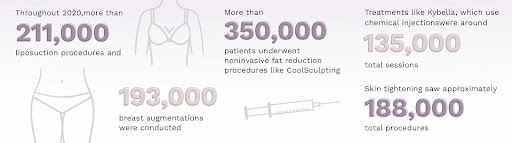
For example, the American Society of Plastic Surgeons reports that its member surgeons performed 349,728 liposuction procedures and 306,196 breast augmentation procedures in 2024. [6] In the minimally invasive category, the same report lists 447,581 non-invasive fat reduction procedures and 439,032 nonsurgical skin tightening procedures in 2024. [6]
Body contouring, especially minimally invasive or noninvasive methods, has become so popular because it offers to help people who are struggling to feel confident or happy with their appearance. Through these treatments, unwanted bulges and pockets of fat can be removed, and areas that appear flat or underdeveloped can be enhanced.
Why Do We Need Body Contouring?
Fat can be stubborn, even with consistent diet and exercise. People can work toward a particular body type for years and still feel like certain areas never respond the way they want.
Body shape is influenced by a mix of genetics and lifestyle. Lifestyle plays a role in weight and muscle tone, but genetics strongly affects where you tend to store fat and how your contours are distributed.
If someone is going to gain weight, there is not much control over where it goes. Even people who eat balanced meals and live active lifestyles can store excess weight in a specific area.
On the other hand, there are areas (like the breasts or buttocks) where someone may want more volume. A person who feels flat or underdeveloped in one area can feel just as self-conscious as someone with too much fat storage elsewhere.
Parents, working professionals, students, and stay-at-home spouses all have an ideal look that helps them feel confident as they move through life. For some goals, body contouring can provide an option when lifestyle changes alone have not delivered the shape a person wants.
Is Body Contouring Safe?
Both surgical and nonsurgical body contouring procedures have established safety profiles when performed by qualified medical professionals. Surgical approaches typically carry more risk and downtime than nonsurgical ones, but the right approach depends on your goals, your anatomy, and your medical history.
A consultation is the best way to confirm candidacy, set realistic expectations, and understand risks and aftercare for your specific treatment.
Body Contouring Areas of Treatment
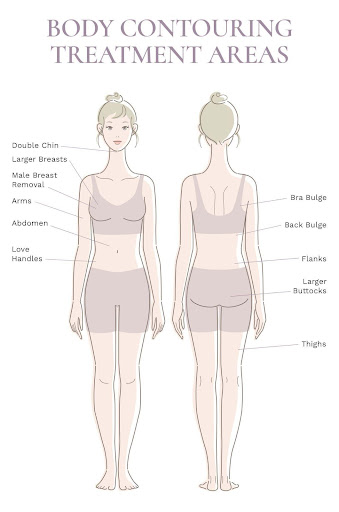
Double Chin
Treatments: CoolSculpting, Kybella
Arms
Treatments: CoolSculpting, Laser Lipo, PelleFirm
Back Bulge
Treatments: CoolSculpting, Laser Lipo
Bra Bulge
Treatments: CoolSculpting, Laser Lipo
Larger Breasts
Treatments: Natural Breast Augmentation
Chest Fullness (Fat-Related)
Treatments: CoolSculpting (when appropriate), Laser Lipo
Abdomen
Treatments: CoolSculpting, Laser Lipo, SculpSure, truSculpt Flex
Love Handles
Treatments: CoolSculpting, Laser Lipo, SculpSure
Flanks
Treatments: CoolSculpting, Laser Lipo, SculpSure
Larger Buttocks
Treatments: Natural Buttock Augmentation
Thighs
Treatments: CoolSculpting, Laser Lipo, SculpSure, truSculpt Flex, PelleFirm, Cellulaze
Types of Body Contouring
Types of body contouring include surgical reshaping and nonsurgical options for fat reduction, muscle definition, skin tightening, and cellulite smoothing. Learn more about the three primary types of body contouring below:
1. Nonsurgical Fat Removal
Nonsurgical fat removal, sometimes called lipolysis, targets small pockets of fat without surgery. Depending on the technology, it may use controlled cooling, heat, lasers, ultrasound, or other energy to disrupt fat cells, and the body clears the affected fat over time. [1][2][7]
Learn more about some popular nonsurgical fat removal methods below:
CoolSculpting
CoolSculpting uses cryolipolysis technology, which kills fat cells by freezing them in the skin. [8] Once dead, the body naturally removes them, revealing a newly defined contour in the treated area. Cryolipolysis treatments like CoolSculpting can reduce the targeted fat layer by as much as 25%. [9]
Cryolipolysis treatments were the most popular body contouring category in 2018 by more than 100,000 procedures. [10] The procedure is safe and effective and one of the most reliable methods of treatment on the market.
- Procedure Length: 30–60 minutes
- Number of Treatments: 2–3 treatments
- Recovery Time: mild redness, swelling, numbness, or soreness can last days to a couple of weeks, individual experiences vary. [1]
- Downtime: none
- Length of Results: long-lasting when weight stays stable, individual results vary. [3]
Kybella
Kybella is a nonsurgical injection that uses a chemical formula to remove excess fat beneath the chin. [11] It was approved by the FDA in 2015 and has since become a staple in the aesthetic industry. [12] It can be a strong option for patients who want to avoid a surgical approach for a double chin.
- Procedure Length: 15–20 minutes
- Number of Treatments: 2–3 treatments
- Recovery Time: swelling and tenderness are common after treatment, some people have significant swelling for up to two weeks. [3]
- Downtime: none
- Length of Results: long-lasting when weight stays stable, individual results vary. [3]
Laser Lipo
Laser liposuction, also known as laser lipolysis, is a liposuction technique that uses concentrated light to help break down fat cells in the targeted area. While laser liposuction may provide more immediate results, it typically comes with more recovery than fully noninvasive options. [13]
- Procedure Length: 60 minutes
- Number of Treatments: 1 treatment
- Recovery Time: one week, minor bruising and soreness
- Downtime: 2–3 days
- Length of Results: long-lasting when weight stays stable, individual results vary.
SculpSure
Similar to laser liposuction, SculpSure uses concentrated light to break away fat cells in unwanted areas. But there is a fundamental difference between the two procedures: laser liposuction requires that a cannula be inserted into the skin, while SculpSure is entirely noninvasive and works directly from the surface of the skin. [14] This makes it a good option for anyone wanting to avoid surgery.
- Procedure Length: 25–35 minutes
- Number of Treatments: 1–3 treatments
- Recovery Time: one week, minor swelling or soreness
- Downtime: none
- Length of Results: long-lasting when weight stays stable, individual results vary. [3]
2. Body Sculpting
Body sculpting is a body contouring category focused on shaping and definition. It can include techniques that refine curves by redistributing your own fat through fat transfer, as well as treatments that emphasize muscle tone for a more athletic-looking outline. [1][2]
Find out more about different types of body sculpting below:
Natural Breast Augmentation
Natural breast augmentation, commonly referred to as breast augmentation with fat transfer, is a breast augmentation method that can improve the size and shape of breasts with more natural results than what can be achieved through implants.
The procedure includes harvesting fat through liposuction and injecting it into your breast area. [15] Since the substance being used is from your own body, there is no chance your body will reject it like an implant. In some cases, natural breast augmentation can nearly double the size of a woman’s breasts through fat transfer alone. [16]
- Procedure Length: 4–6 hours
- Number of Treatments: 1 surgery
- Recovery Time: 4–6 weeks, bruising, swelling, pain, and discomfort
- Downtime: 1–3 days
- Length of Results: long-lasting, some fat reabsorption can occur and results vary.
truSculpt Flex
truSculpt Flex focuses more on muscle definition than fat. It uses multi-directional stimulation technology to mimic the effects of an intense workout, helping to improve muscle tone and definition in targeted areas. This device can address up to eight body parts at once, making it a highly efficient body contouring procedure.
- Procedure Length: 45–60 minutes
- Number of Treatments: 4–6 treatments
- Recovery Time: 1–3 days, mild swelling or discomfort
- Downtime: none
- Length of Results: 6–12 months
3. Skin Tightening
Skin tightening treatments are designed to improve laxity by stimulating collagen and elastin in deeper layers of the skin. Most non-invasive skin tightening devices use laser, radiofrequency, or ultrasound energy, or a combination of these, to deliver controlled heat that supports firmer-looking skin over time. [4]
Review some of the primary skin tightening treatments below:
PelleFirm
As we age, our bodies produce fewer and fewer of the essentials responsible for keeping our skin taut and youthful. [17] PelleFirm uses radiofrequency energy to heat and damage the skin enough to trigger the body’s natural healing response, including an influx of proteins like collagen and elastin that can improve skin firmness.
- Procedure Length: 45–60 minutes
- Number of Treatments: depends on the condition
- Recovery Time: 1–3 days, mild swelling or redness
- Downtime: none
- Length of Results: results vary, maintenance treatments may be recommended.
Cellulite Removal
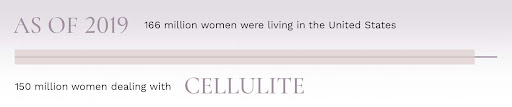
Cellulite is one of the most common aesthetic problems people face. In industrial nations like the United States, cellulite affects around 90% of all women and 10% of all men. [18]
Cellulaze
During a Cellulaze treatment, a tiny cannula is inserted into the skin where cellulite is present. Laser energy is then delivered into the skin, breaking the fibrous bands that cause cellulite and creating a smoother appearance on the skin’s surface.
- Procedure Length: 1–2 hours
- Number of Treatments: 1 treatment
- Recovery Time: 2–3 weeks, bruising, swelling, or soreness
- Downtime: 2–3 days
- Length of Results: long-lasting, individual results vary.
Cost of Body Contouring
Finding accurate cost estimates can be difficult, especially since your specific cost will vary greatly depending on your conditions and aesthetic goals. To help give you an idea of what you will spend, we put together this graph for your reference:
| CoolSculpting | $1,000 – $4,000 |
| Kybella | $1,200 – $1,800 |
| Laser Lipo | $2,500 – $4,500 |
| SculpSure | $1,500 – $3,000 |
| Natural Breast Augmentation | $4,000 – $7,000 |
| truSculpt Flex | $600 – $800 |
| PelleFirm | $500 – $1,500 |
| Cellulaze | $4,000 – $7,000 |
Body Contouring FAQ
Is Body Contouring Permanent?
Results can be long-lasting with stable weight, but they are not guaranteed forever, and some treatments need maintenance or follow-up over time.
When a treatment destroys or removes fat cells, those specific cells do not come back, but remaining fat cells can still expand with weight gain. Some device-based treatments are also cleared to temporarily improve the look of a concern, which is why long-term outcomes depend on the technology and your habits after treatment. [1][3]
How Many Treatments Will I Need?
Treatment count depends on the technology, area, and goal, and many noninvasive options work best as a series planned during your consultation.
Your plan can range from a single session to a short series. Your provider should outline the expected number of treatments, the spacing between sessions, and whether maintenance is recommended based on your goals and the device being used. [1]
Does Body Contouring Tighten Loose Skin?
Some treatments can improve mild to moderate laxity by heating deeper tissue to support collagen, but significant loose skin usually needs a different approach.
Energy-based tightening can improve the look of mild laxity over time, but outcomes vary based on age, skin quality, and how much looseness is present. If there is significant excess skin, your provider can talk through alternatives that better match your goal. [4]
Can Body Contouring Treat the Breast Area?
Noninvasive body contouring devices are not cleared by the FDA for treating the breast, so planning focuses on the specific concern and safe alternatives.
If your concern involves fullness near the chest, your provider can help identify what is driving the appearance and whether an option like fat reduction around the area is appropriate. A consultation is the best way to confirm which treatments are safe and suitable for your goals. [1]
What Is the Difference Between Surgical vs Nonsurgical Body Contouring?
Surgical body contouring typically removes, repositions, or transfers fat (and sometimes tightens skin), which can deliver more dramatic changes but requires more recovery.
Nonsurgical body contouring uses device-based energy or injections to reduce fat, tighten skin, or improve muscle definition with little to no downtime. Results tend to appear gradually.
Your provider can help you choose the right approach based on your goals, your timeline, and the area you want to treat.
Dermacare Laser and Skin Care Clinics
Dermacare is an industry leader in the worldwide laser and cosmetic industries. We have two offices — San Diego and Carlsbad — led by Dr. Birchall, a top provider of body contouring procedures. We have been recognized widely for our contributions to the aesthetic and cosmetic industries and are committed to providing you with the best possible experience and results. We also recommend that all of our patients join Allé, a rewards program and resource for cosmetic treatments.
If you’re interested in body contouring, learn more about our body contouring treatments today.
Works Cited
- [1] https://www.scienceofpeople.com/beauty-standards/
- [2] https://www.plasticsurgery.org/
- [3] https://www.healthline.com/
- [4] https://pubmed.ncbi.nlm.nih.gov/19296153/
- [5] https://www.statista.com/
- [6] https://www.healthline.com/health/kybella
- [7] https://www.accessdata.fda.gov/
- [8] https://www.healthline.com/health/laser-lipo-vs-coolsculpting
- [9] https://www.cynosure.com/product/sculpsure/
- [10] https://www.plasticsurgery.org/cosmetic-procedures/fat-transfer-breast-augmentation
- [11] https://www.plasticsurgery.org/news/press-releases/new-technique-doubles-breast-size-using-patients-own-fat
- [12] https://www.scientificamerican.com/
- [13] https://www.scientificamerican.com/article/is-cellulite-forever/
- [14] https://www.census.gov/data/developers/data-sets/acs-1year.html