If you’re interested in receiving dermal filler injections to smooth wrinkles and restore volume to sagging skin, one option you’ll likely want to consider is Sculptra. This Poly-L-lactic acid (PLLA) filler stimulates collagen and offers longer-lasting effects than many other dermal fillers.
As you try to decide on the right filler for your goals, review our guide to Sculptra to see if it’s right for you.
Table of Contents
What Is Sculptra?
Sculptra is an injectable treatment made with poly-L-lactic acid that helps soften facial wrinkles by encouraging your skin to rebuild collagen gradually.
Sculptra Aesthetic is FDA-approved for correcting shallow to deep nasolabial folds and other facial wrinkles, and for treating fine lines and wrinkles in the cheek region in immunocompetent adults.
Instead of acting like a gel that instantly fills space, Sculptra stimulates your skin’s own collagen response so the improvement can look subtle and natural as it develops.
How Does Sculptra Work?
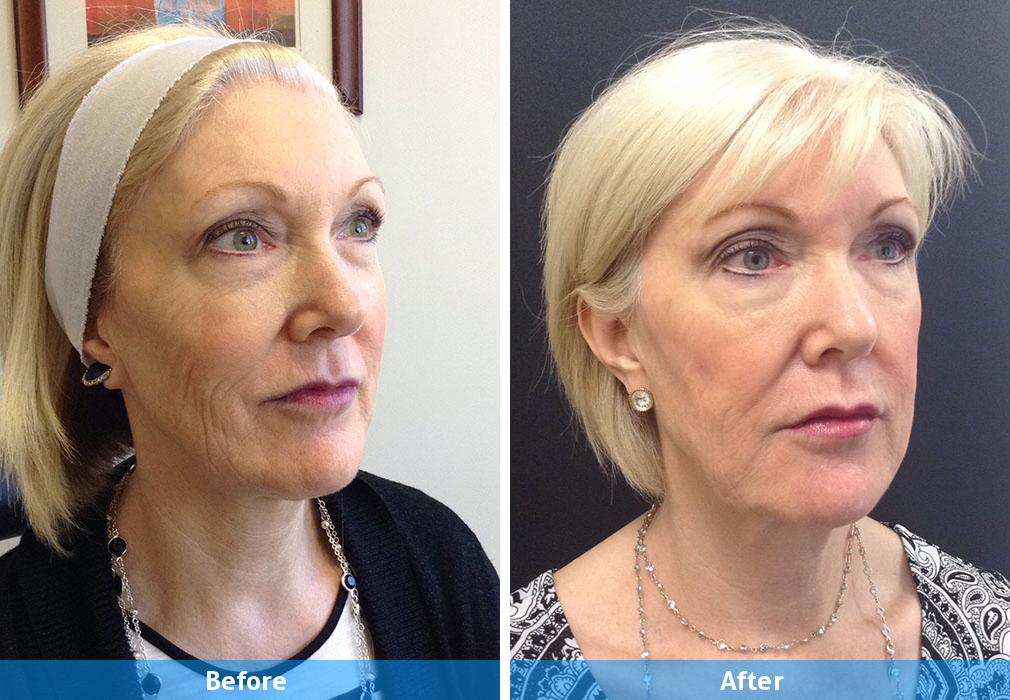
Sculptra works by injecting tiny poly-L-lactic acid particles beneath the skin to prompt collagen production, resulting in gradual improvements in volume and a smoother appearance over several weeks.
Right after treatment, you might notice mild swelling that comes from the fluid used during injection. The longer-term change comes as your body responds by building new collagen where the product was placed.
Since correction develops over time, experienced injectors avoid “overcorrecting” during the first session and plan a series that builds toward your goal.
What Does Sculptra Treat?
Sculptra is used to restore facial volume and soften wrinkles, with FDA-cleared uses that include nasolabial folds, other facial wrinkles, and cheek-region fine lines.
Where Does Sculptra Treat?
Providers often use Sculptra for areas where facial volume loss shows up as hollowing or deeper folds. Common locations that Sculptra treats include:
- Cheeks
- Temples
- Jawline/Chin
- Nasolabial Folds (Smile Lines)
- Marionette Lines
How Many Sessions are Needed for Sculptra?
Sculptra is typically done as a series, often two to four sessions spaced about a month apart. After these sessions, patients receive maintenance as needed to support collagen-backed volume.
How Long Does Sculptra Last?
Many patients keep their Sculptra results for around two years or longer, but the duration varies based on treatment plan, anatomy, and how your body responds.
Sculptra Before and After Images
Who Is a Good Candidate for Sculptra?
Good candidates are healthy, immune-competent adults who want gradual, natural-looking facial volume restoration.
Sculptra is often a strong fit if you’ve started noticing volume loss that makes the cheeks look flatter, the midface look less supported, or folds look more pronounced. It’s also a good option if you prefer results that build over time rather than a dramatic change right away.
Because this treatment works gradually, it tends to suit patients who can commit to an individualized series and follow post-care instructions. Your provider will also evaluate your skin quality and the areas you want to treat to confirm that a collagen-stimulating injectable is the best match for your goals.
If you’re pregnant, breastfeeding, or under 18, talk with your provider first. Safety and effectiveness haven’t been evaluated in these groups, so many providers recommend waiting.
Who Shouldn’t Get Sculptra?
Sculptra isn’t recommended for people with severe allergies, sensitivities to its ingredients, or a tendency to form keloids or hypertrophic scars.
Before treatment, your provider should review your allergy history and how your skin heals. Sculptra should not be used if you have a history of severe allergic reactions like anaphylaxis, if you have multiple severe allergies, or if you’re allergic to any of its ingredients.
It isn’t recommended for patients with a known history of, or susceptibility to, keloid formation or hypertrophic scarring. If your treatment plan includes mixing Sculptra with lidocaine for comfort, your provider will also screen for lidocaine allergy.
What Are Sculptra’s Side Effects?
Common side effects include temporary swelling, bruising, redness, and tenderness. There’s a lower risk of delayed papules or nodules and of very rare, serious vascular complications.
What Aftercare Is Recommended for Sculptra?
Aftercare typically includes gentle cold compresses, the 5-5-5 massage routine, and protecting the treated area from sun, UV lamps, and extreme temperatures until swelling and redness resolve.
Your provider may recommend a cool compress shortly after treatment to help with swelling and bruising. From there, most patients are instructed to massage the treated areas in a circular motion for 5 minutes, 5 times per day, for 5 days, unless your provider tells you otherwise.
A few other practical guidelines can help you heal smoothly:
- Aesthetic make-up may be applied a few hours after treatment if no complications are present.
- Avoid sun or UV lamp exposure and extreme temperatures until early swelling and redness have resolved, and follow your provider’s sunscreen guidance.
- Call your provider if swelling, bruising, pain, or redness gets worse instead of improving, or if you notice new lumps or bumps that concern you.
How Does Sculptra Compare to Other Injectables?
Injectable fillers come in different material types, and each one supports different goals for timing, feel, and longevity. For example, some fillers are gels that add volume right away, while others are microspheres or particles that provide structure or encourage your skin to rebuild collagen over time.
Common filler types include hyaluronic acid (HA) gels, calcium hydroxylapatite (CaHA) based fillers, PMMA microsphere fillers, and PLLA fillers like Sculptra. Find out more about the primary differences between these fillers below:
Sculptra vs Radiesse (CaHA Filler)
Radiesse’s base is a CaHA-based filler, with CaHA being a mineral-like compound related to what’s found naturally in bones. In filler form, CaHA is used for deeper wrinkles and folds and for adding more structural support in certain areas.
Radiesse can be a good fit for patients who want more immediate support and definition in select areas, while Sculptra tends to suit patients looking for a gradual collagen-building approach that improves volume over time.
If your goal is a progressive, natural-looking refresh and you’re comfortable with multiple appointments, Sculptra can be a better match. If you want more instant structure and contouring, CaHA-based fillers may be better for your needs.
Sculptra vs Juvéderm (HA Filler)
Juvéderm Ultra XC uses HA, which is a substance naturally found in the body that binds water. When HA is used as an injectable gel, it can add volume quickly and smooth wrinkles and folds. Many HA fillers like Juvéderm are also considered adjustable because they can be treated with hyaluronidase if a correction needs to be reduced.
Compared with Juvéderm, Sculptra can be a better fit for patients who want gradual, collagen-supported volume and a more progressive change that develops over multiple sessions.
HA fillers may be a better match when you want more immediate shaping, when you’re treating areas where HA is commonly used for precision, or when you value the option to dissolve the product.
Sculptra vs Bellafill (PMMA Filler)
Bellafill is a PMMA microsphere filler suspended in bovine collagen gel. PMMA uses tiny microspheres designed to stay in place long term, which is why it’s often described as semi-permanent. Bellafill labeling also requires a skin test before treatment, and it has been FDA-approved to treat nasolabial folds and certain acne scars on the cheek.
Bellafill may appeal to patients seeking very long-lasting correction and who are good candidates for a PMMA product with the required safety measures. In contrast, Sculptra may be a better fit for patients seeking a collagen-stimulating option that is biodegradable and gradually builds volume.
Begin Your Sculptra Treatments in San Diego at Dermacare
If you’re interested in receiving Sculptra injections in San Diego, Carlsbad, San Juan Capistrano, or the surrounding areas, our team at Dermacare is ready to help you. During your first visit, we’ll conduct a comprehensive consultation to discuss your goals and needs. Once we’ve verified that Sculptra is the best treatment for you, we’ll perform the injections in only a few minutes, ensuring you’re comfortable throughout.
Learn more about our Sculptra injectable treatments today. If you’re ready to get started, please schedule an appointment.