Key Takeaways
- Potenza RF microneedling sends radiofrequency energy into the skin through ultrafine needles, prompting new collagen and elastin at a depth needles alone cannot reach.
- Heat separates Potenza from traditional microneedling, making Potenza a better fit for skin laxity and deeper scarring, and traditional microneedling a better fit for early fine lines and surface texture.
- Potenza's four modes reach depths of up to 4 mm and let a provider treat concerns sitting at different depths in a single appointment, on the face or the body.
- Morpheus8's FDA clearance limits its highest energy settings to fair through light-brown skin, while Potenza's clearance includes no skin-type restriction.
- Darker skin tones carry a higher risk of pigment changes after laser resurfacing, so complexion affects candidacy far more with lasers than with radiofrequency treatments.
Two concerns send most people looking into skin treatments. One is skin texture, meaning rough patches, enlarged pores, or the marks acne leaves behind. The other is firmness, when skin along the jaw or neck starts to give way.
Microneedling addresses both, up to a point. During a microneedling appointment, very fine needles create controlled punctures. Your body then reads these punctures as an injury and repairs the area with fresh collagen and elastin. The effect stays close to the surface.
Radiofrequency pushes that process deeper. Potenza, Morpheus8, and other RF microneedling treatments all add radiofrequency energy to the needles, which leaves most people choosing between treatments described in nearly identical words.

What Is Potenza RF Microneedling?
Potenza RF microneedling is a treatment that sends radiofrequency energy into the dermis through ultrafine needles, prompting your skin to produce new collagen and elastin.
In a single pass, the device does two separate jobs. The needles create tiny channels that your body reads as an injury, activating fibroblasts, the cells that build collagen and elastin. Radiofrequency energy travels down those same needles into the dermis, the living layer beneath the surface where your skin’s structural support sits.
Since warmth acts on collagen that is already in place, heat does something the needles alone cannot. Existing fibers tighten as they warm, firming skin in the short term, and the same warming prompts fresh collagen over the following months. Microneedling alone produces the second effect. With radiofrequency, you get both.
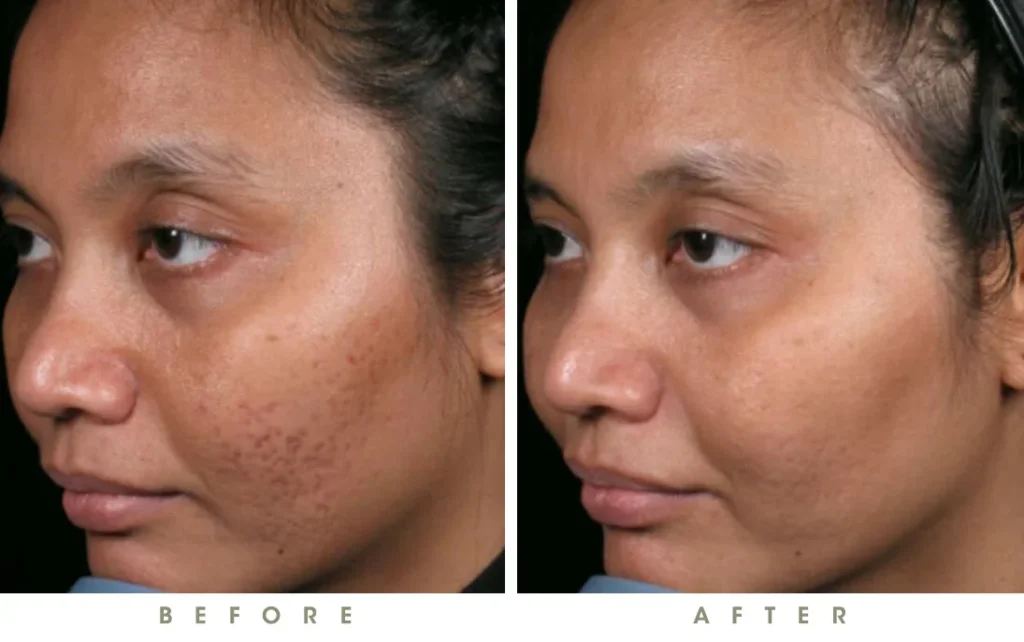
How that energy arrives is adjustable, and it comes down to two options. One keeps the heat tightly concentrated around each needle, which suits precise work closer to the surface. The other spreads heat more widely and reaches further down, which suits firmness.
Potenza offers both, and your provider selects between them based on what your skin needs. Each option also runs at two frequencies, which gives Potenza four modes in total.
With four modes to work from, one device can address several concerns.
- Texture and pore size: Shallower settings work close to the surface, where roughness and enlarged pores sit.
- Fine lines and mild looseness: Deeper heating tightens the collagen already there and prompts your skin to build more over the following months.
- Acne scarring and stretch marks: The needles break up scar tissue while the heat encourages the surrounding skin to rebuild more evenly.
- Face and body, year-round: Cynosure markets Potenza for use anywhere on the body and at any time of year, which sets it apart from some resurfacing lasers.
How Potenza RF Microneedling Compares to Microneedling, Morpheus8, and Laser Resurfacing
Choosing between these treatments comes down to matching the depth of the concern to the depth of the treatment.
Potenza vs. Traditional Microneedling
Heat is the main difference between Potenza microneedling and traditional microneedling, and it determines which suits you.
Heat travels past the surface into the deeper dermis, tightening collagen that is already there and prompting new growth at a depth needles alone never get to. The extra depth matters most for mild looseness, deeper acne scarring, and loose or crepey skin on the body. Skin on the abdomen, arms, and thighs is thicker than facial skin, so a shallow treatment has little to work with there.
Traditional microneedling works through the needles by themselves. A pen or roller creates the same controlled micro-injuries, your body responds the same way, and fresh collagen forms over the weeks that follow. Without the heat, the effect stays closer to the surface and builds more gradually across a series of sessions.

Skin laxity, deeper scarring, and texture that hasn’t shifted with gentler treatments all point toward Potenza, along with body areas where thicker tissue needs the extra depth. A course of traditional microneedling suits early fine lines, surface texture, and general skin quality. It also asks less of you in recovery, and anyone whose skin still holds its shape may need nothing more.
Potenza vs. Morpheus8
Potenza and Morpheus8 differ most in range and skin tone. Morpheus8 delivers only the concentrated kind of energy. Potenza offers that same delivery as well as the wider, deeper kind, which gives a provider more ways to match the treatment to the area.
Skin tone is where the clearest practical difference shows up. Above 62 millijoules per pin, the FDA clearance for Morpheus8 limits use to Fitzpatrick skin types I through IV, a dermatology scale that runs from very fair to light brown skin. The clearance places no skin-type limit on lower settings. Potenza’s clearance doesn’t include a skin-type restriction at all.
Research on radiofrequency treatments in darker skin is also encouraging. A 2023 review of 35 studies found a low risk of scarring or pigment changes, though the authors noted that much of the evidence was limited.

Potenza vs. Other RF Microneedling Devices
Most radiofrequency microneedling systems deliver only one kind of energy. What sets Potenza apart is its range. Its four modes let a provider move between shallow, precise work and deeper, broader heating without switching devices.
In practice, Potenza’s range shows up in three ways.
- Concerns at different depths: Surface texture and looseness further down can be treated in the same appointment rather than split across two.
- Face and body: Depths reach up to 4 mm, enough for thicker skin on the neck, chest, and body as well as the face.
- Single spots and small areas: A separate handpiece treats individual blemishes directly instead of passing over the whole area.
Potenza vs. Laser Resurfacing
Resurfacing lasers heat or remove thin columns of skin to prompt regrowth, which makes them good for treating sun damage, brown spots, and fine lines. Recovery usually takes longer. Radiofrequency microneedling leaves most of the surface intact and works underneath it, so recovery tends to be quicker and the effect on discoloration is usually smaller.
Skin tone factors in differently. Darker complexions face a higher risk of pigment changes after laser resurfacing, meaning candidacy depends more on skin tone than it does with radiofrequency. Any conversation about laser resurfacing options should cover that risk.

Potenza, Morpheus8, and Other RF Devices at a Glance
Three specifications account for most of the practical difference between these devices. The rest of what a clinic advertises tends to be common across the category.
| Potenza | Morpheus8 | Most other RF devices | |
|---|---|---|---|
| Energy delivery | Concentrated and deep-spreading | Concentrated only | Concentrated only |
| Needle depth | Up to 4 mm | Up to 4 mm or 7 mm, depending on the tip | Varies by device |
| Skin-type restriction in FDA clearance | None listed | Fitzpatrick I–IV above 62 mJ/pin | Varies by device |
Weigh Potenza, Microneedling, and Lasers with Dermacare
Comparing devices on paper only gets you so far. Dermacare Medical Aesthetics offers Potenza at its Rancho Bernardo and Carlsbad locations alongside traditional microneedling and laser resurfacing, so a consultation can weigh all three options against your skin. Jeff Birchall, M.D., directs care across the practice with more than 25 years in aesthetic medicine, and the team behind him carries over 60 years of combined experience.
Learn more about Potenza and traditional microneedling at Dermacare. To talk through your options in person, find the location nearest to you.