Laser Skin Rejuvenation in Rancho Santa Margarita, CA
AT DERMACARE MEDICAL AESTHETICS

If you have brown spots scattered across your cheeks, a flush that never quite settles, or marks a breakout left behind months ago, light-based treatment is usually the most direct way to clear them. Neither of the treatments we use asks you to take time off or stay home while your skin recovers.
Dermacare Medical Aesthetics treats the brown and the red as separate problems, because they respond to different light. Our San Juan Capistrano clinic runs the IPL FotoFacial for sun spots, freckling and visible capillaries, and Laser Genesis for diffuse redness and rosacea, both under the direction of a board certified physician.
We are in San Juan Capistrano, a 20 minute drive from Rancho Santa Margarita. Book a consultation and someone will look at your skin properly, tell you which marks light can clear and which ones it cannot, and give you a real number of sessions before you commit to anything.
Dermacare San Juan Capistrano
Med Spa · 20 minutes from Rancho Santa Margarita
31371 Rancho Viejo Rd. Suite 201
San Juan Capistrano, CA 92675
Hours
| Monday | 8:00am – 4:00pm |
| Tuesday | 8:00am – 4:00pm |
| Wednesday | 10:00am – 6:00pm |
| Thursday | 8:00am – 4:00pm |
| Friday | 8:00am – 4:00pm |
| Saturday | Closed |
| Sunday | Closed |
There Are Three Kinds of Brown, and Only One of Them Clears Easily
Most people arrive asking about their dark spots as though the spots were one thing. They are usually three, sitting side by side on the same cheek, and they behave completely differently under a light-based treatment.
| What it is | How to recognize it | What drives it | What light does to it |
|---|---|---|---|
| Sun spots (solar lentigines) | Flat, separate, fairly crisp edges, tan to dark brown. Most dense where the sun lands: tops of the cheeks, the nose, the forehead, the backs of the hands | Years of accumulated UV | Responds well. This is the treatment IPL was built for |
| Melasma | Larger patches with soft, blurry edges, roughly symmetrical across both cheeks, the forehead or the upper lip. Often darker in summer | UV, heat, visible light and hormones together | Improves, then usually returns. Can be made worse |
| Post-inflammatory marks | Brown sitting exactly where a pimple, a scratch or an ingrown hair used to be | Inflammation that has already resolved | Fades on its own in most cases. Light is rarely the answer |
Knowing which of the three you are looking at is most of the decision, and it is the part a mirror cannot settle for you. A sun spot and a patch of melasma can sit two centimeters apart and need opposite advice.
How Laser Skin Rejuvenation Can Help with Redness
Redness gets filed under skin tone and left there, and it splits into at least three problems with different answers.
Individual visible vessels.
Fine red or purple lines, usually around the nostrils, across the cheeks, or at the outer edge of the chin. They are discrete enough to point at. IPL targets them by color, the same way it targets a brown spot.
Diffuse background redness and flushing.
No single vessel to aim at, just a sustained pink across the central face that gets worse with heat, wine, exercise and stress. This is the rosacea pattern, and because there is no distinct target, broad heating works better than color targeting. Laser Genesis is the treatment built for it: a non-ablative laser that warms the upper dermis without a pigment target at all.
Red and brown mottling on the neck and chest.
The medical name is poikiloderma of Civatte, and it is the reddish-brown speckling that collects on the sides of the neck and the upper chest after decades of sun, usually sparing the shaded patch under the chin. It is extremely common in Southern California and almost never named out loud. Dermacare treats it with Laser Genesis.
Laser Genesis runs about five sessions spaced roughly a month apart, with no downtime at all, and the full result shows up around twelve weeks after the course. It holds for six to twelve months before most people want a top-up. It is also the option that carries no skin tone restriction, which matters more than it sounds.
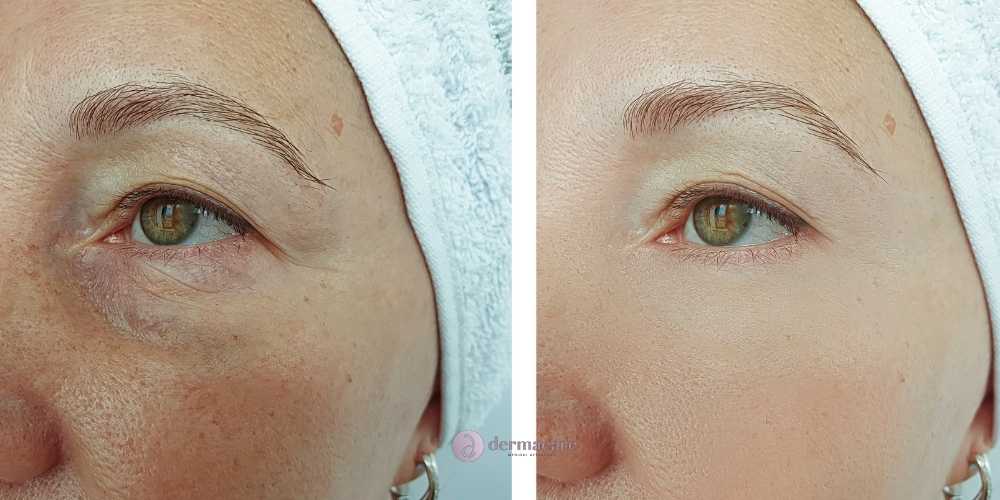
Before and After Laser Skin Rejuvenation at Dermacare Med Spa Near Rancho Santa Margarita, CA
IPL FotoFacial or Laser Genesis
| IPL FotoFacial | Laser Genesis | |
|---|---|---|
| How it works | Broadband light absorbed by anything darker or redder than the surrounding skin | Gently heats the upper dermis across the whole area, with no color target |
| Built for | Discrete sun spots, freckling, visible individual capillaries | Diffuse redness, rosacea flushing, poikiloderma on the neck and chest, pore refinement |
| Sessions | One to three for most sun damage | About five, roughly a month apart |
| Downtime | None. Pink for an hour or two, makeup the same day. Treated spots darken for several days before flaking away | None |
| Skin tone | Best on light to medium untanned skin. Not recommended on deeper tones without a patch test | No restriction. Works across skin types |
| When you see it | Spots lift over the first two weeks | Around twelve weeks, holding six to twelve months |
Plenty of people end up having both, usually IPL first to clear the discrete spots and Laser Genesis afterward to settle the background. That sequence is a conversation at a consultation rather than something to decide from a table.
Why Anyone Asks About Your Tan Before Pointing a Light at You
IPL works best with contrast. The light from the laser is absorbed by whatever patch of skin is the darkest, so a brown spot sitting on pale skin is an easy target and the skin around it is ignored. Take away the contrast with tanned skin, and laser treatment gets more tricky: the surrounding skin starts absorbing energy too, and the burn, blister or patch of uneven pigment that follows lands on the normal skin rather than the spot.
When Light Is Not the Answer
Three things get brought to a laser consultation that a light-based treatment will not fix.
Spots you can feel.
If a brown spot is raised, waxy or rough to a fingertip rather than flat, it is probably a seborrheic keratosis, which is a growth rather than a pigment deposit. IPL will not remove it. It comes off a different way, and it needs someone to look at it properly first.
Texture, acne scarring and deeper lines.
Color treatments change color. Nothing on this page remodels the surface of the skin or fills a scar. That work is fractional resurfacing, and the LUX 1540 fractional laser at San Juan Capistrano is the device for it. Our laser skin resurfacing page covers how that treatment works, what it costs and what the recovery involves.
Any spot that has changed.
A mark that has grown, darkened unevenly, developed a ragged border, itched or bled is a dermatology question before it is a cosmetic one. Nobody at Dermacare will treat it with light to find out. Get it looked at, then come back for the rest.
Who Will Be Running the Laser
Ask two questions before booking a light treatment anywhere, this clinic included. Who physically holds the handpiece, and who chose the settings. At a lot of practices those are two different people, and at some of them they are the same person without medical oversight.
Jeff Birchall, M.D. directs the medical side of Dermacare Medical Aesthetics. He is board certified with more than twenty-five years in aesthetic medicine, and laser treatments at the San Juan Capistrano clinic are carried out under his direction.
The second question worth asking of any practice is which device they are actually putting on your face and why that one. “Laser skin rejuvenation” is a category, not a treatment, and four clinics using the phrase can mean four unrelated machines.

Getting Here From Rancho Santa Margarita
The clinic is at 31371 Rancho Viejo Rd, Suite 201 in San Juan Capistrano, south of Rancho Santa Margarita. The route is shared by Dove Canyon, Coto de Caza, Las Flores and Trabuco Canyon.
Neither treatment on this page needs time off, so a session fits around a working day, and the late Wednesday hours below suit anyone who cannot get away before lunch. Worth starting a course in fall or winter rather than mid-summer, since both treatments ask you to stay out of the sun on either side and that is a harder promise to keep in July.
Dermacare San Juan Capistrano
Med Spa · San Juan Capistrano, CA
31371 Rancho Viejo Rd. Suite 201
San Juan Capistrano, CA 92675
Hours
| Monday | 8:00am – 4:00pm |
| Tuesday | 8:00am – 4:00pm |
| Wednesday | 10:00am – 6:00pm |
| Thursday | 8:00am – 4:00pm |
| Friday | 8:00am – 4:00pm |
| Saturday | Closed |
| Sunday | Closed |
Questions About Pigment and Redness

What is the difference between melasma and sun spots?
Sun spots are separate, flat, fairly crisp-edged brown marks that land where the sun hits hardest and come from accumulated UV. Melasma shows up as larger patches with soft, blurred edges, usually symmetrical across both cheeks, the forehead or the upper lip, and it is driven by hormones, heat and visible light as well as UV. Sun spots respond well to light-based treatment. Melasma improves and then tends to come back.
Can IPL make melasma worse?
It can, and that is the main reason to identify melasma before treating it. Light-based treatment of melasma carries a real rate of post-inflammatory darkening, more so in deeper skin tones, and a 2025 review in the Indian Journal of Dermatology recorded recurrence in 11 to 33 percent of patients depending on the protocol. Used as an addition to prescription topical treatment it performs well. Used on its own as the whole plan, it is the approach most likely to disappoint you.
Is IPL a laser?
No, and the difference is worth knowing when you are comparing quotes. A laser emits one wavelength of light aimed at one target. IPL emits a broad band of wavelengths, filtered to hit several targets at once, which is why a single IPL session can address brown spots and red vessels in the same pass. It also means IPL is less precise than a laser, which is the trade you are making when a clinic quotes you a lower price for a photofacial than for a laser treatment.
What is the difference between IPL and Laser Genesis?
IPL finds its target by color, so it works on things that are distinctly browner or redder than the skin around them: sun spots, freckles, individual capillaries. Laser Genesis has no color target at all and instead warms the upper dermis across the whole treated area, which suits diffuse redness, rosacea flushing and texture. IPL is typically one to three sessions. Laser Genesis is about five, spaced a month apart.
Can I have IPL if I have a tan?
No, not until it fades. IPL relies on your spots being darker than the skin around them, and a tan narrows that gap until the surrounding skin starts absorbing the energy as well. That is how a treatment meant to remove a spot ends up causing a burn or a patch of uneven color instead. The same logic is why deeper skin tones need a patch test first or a different treatment.
Does IPL help with rosacea and facial redness?
It helps most with the discrete visible vessels, the fine red lines you can point to around the nose and cheeks. For the diffuse background flushing that rosacea is better known for, there is no single target to aim at, and Laser Genesis tends to be the better fit because it heats the area broadly instead. Many people with rosacea have both patterns and get a course of each.
What is poikiloderma of Civatte?
The reddish-brown mottling that builds up on the sides of the neck and the upper chest after years of sun, usually leaving a clear shaded patch under the chin where the light never reached. It is extremely common and rarely named. Dermacare treats it with Laser Genesis.
Why did a brown mark appear where my pimple was?
That is post-inflammatory hyperpigmentation, which is pigment left behind by inflammation that has already settled. Unlike a sun spot it usually fades without treatment, though it can take months. It is worth waiting out before paying to remove it, and worth treating the acne itself in the meantime, since each new breakout leaves a new mark.
Will my brown spots come back?
Sun spots that are properly cleared tend to stay gone, but new ones keep forming wherever UV keeps landing, so daily sunscreen is what determines whether you are maintaining a result or repeating a treatment. Melasma is different and should be expected to return without ongoing topical maintenance, which the published studies put at six to twelve months after a course of light treatment.
Which sunscreen should I use if I have melasma?
A broad spectrum SPF 30 or higher with iron oxide in it. Melasma reacts to visible light as well as ultraviolet, and iron oxide is the ingredient that blocks visible light, which is why the American Academy of Dermatology points melasma patients toward it specifically. In practice that usually means a tinted mineral sunscreen rather than a clear one.
Come In and Have Someone Look Properly
Come in with the marks, not with a device name. Sorting melasma from sun spots from post-inflammatory marks takes a few minutes in person and changes the entire plan, and it is not a judgment worth making from a photograph or a web page.
Further detail lives on the IPL FotoFacial and Laser Genesis pages, along with hours and directions for the San Juan Capistrano clinic. To book, call (949) 264-8216 or reserve a consultation online.
