Laser Hair Removal in Ladera Ranch, CA
AT DERMACARE MEDICAL AESTHETICS
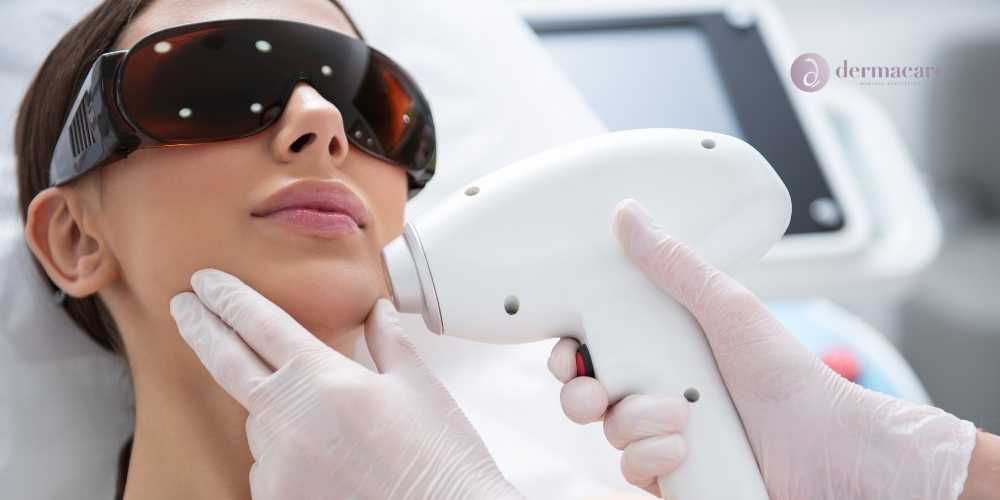
Tired of shaving, but wondering if laser will actually work on your hair and skin? Most people booking laser hair removal aren’t looking for a sales pitch—they want an honest answer before committing to a package of six sessions. At Dermacare, our board-certified medical director sets custom clinical protocols for every skin tone and hair profile. We evaluate your skin and hair in person first, explain exactly what results to expect, and tell you plainly if laser isn’t the right tool for the job.
We are in San Juan Capistrano, a 15 minute drive from Ladera Ranch. Book a consultation and you will leave knowing whether this is worth your money.
Dermacare San Juan Capistrano
Med Spa · 15 minutes from Ladera Ranch
31371 Rancho Viejo Rd. Suite 201
San Juan Capistrano, CA 92675
Hours
| Monday | 8:00am – 4:00pm |
| Tuesday | 8:00am – 4:00pm |
| Wednesday | 10:00am – 6:00pm |
| Thursday | 8:00am – 4:00pm |
| Friday | 8:00am – 4:00pm |
| Saturday | Closed |
| Sunday | Closed |
What the Laser Is Actually Aiming At
Hair removal lasers don’t target hair; they target melanin (pigment) inside the hair shaft.
When calibrated light hits that pigment, it converts to heat, travels down the shaft, and disables the follicle structure at the root. That simple optical science leads to two direct rules:
Hair color determines whether the laser can see the target.
Skin tone determines how the laser must be calibrated to protect your surface tissue.
Because your skin also contains melanin, treating unwanted hair safely requires dialing in the right wavelength, pulse duration, and cooling settings. Matching those variables to your individual biology is where safety and results happen.
Hair Color: An Honest Breakdown
Before you spend a dollar on treatment packages, here is the clinical reality of what laser can and cannot treat:
Dark Brown & Black Hair
The ideal candidates. Rich in eumelanin, these follicles absorb energy efficiently and show the fastest, most noticeable reduction.
Dark Blonde & Light Brown Hair
Responsive, but typically requires more sessions and precise wavelength settings.
Red Hair
Red strands contain pheomelanin instead of eumelanin. Most lasers struggle to heat these follicles adequately, though coarse auburn hair can sometimes yield partial results.
Very Light Blonde, Gray & White Hair
Completely devoid of target melanin. Lasers cannot generate heat in a hair shaft with no pigment. Any clinic promising laser results on gray or platinum hair is selling something physics cannot deliver.

If Your Hair Is Blonde, Red, Gray or White
Gray and white hair have lost their pigment almost entirely. There is nothing in the shaft for the laser to heat, so the follicle never gets the dose, and no number of sessions changes that. Very light blonde hair has the same problem to a slightly lesser degree. Red hair carries pheomelanin rather than the eumelanin these lasers are tuned for, and it responds poorly for the same underlying reason.
Dark blonde and light brown hair sit in between. They respond, usually more slowly and less completely than dark hair does, and that is a reasonable conversation to have with a number of sessions attached.
What this means in practice is that a mixed area often splits. Plenty of people have an upper lip or a chin where the coarse dark hairs clear well and a scattering of fine light ones stays exactly where it was. That is not a treatment that failed. It is the laser doing precisely what it does, to the hairs it can see.
If the hair you want gone is light, electrolysis treats each follicle directly with an electric current and does not depend on pigment at all. It is slower and it is done hair by hair, and for scattered light hairs it is the honest answer. Our page on laser and electrolysis for hormonal hair goes through where each one fits.
Look at the hair in daylight rather than bathroom light before your consultation. Most people are surprised how much lighter it is than they thought.
Darker Skin, and the Settings That Keep It Safe
If you have deeper skin, you have probably been told somewhere that laser hair removal is not for you. Luckily, that advice is about fifteen years out of date!
The original hair removal lasers used short wavelengths that melanin absorbs very strongly. On light skin with dark hair that is ideal, since almost all the absorption happens in the hair. On deeper skin the epidermis absorbs a large share of the energy before it ever reaches the follicle, which means less effect on the hair and more heat where you do not want it. Burns, blistering and lasting changes in pigment, lighter or darker patches that can take months to settle, all come from that same mismatch.
Longer wavelengths changed the arithmetic. Light further into the infrared is absorbed less avidly by melanin and penetrates deeper, so proportionally more of the energy reaches the follicle and less is spent in the surface layers. Pair that with surface cooling, lower fluence and longer pulse durations, and deeper skin can be treated safely. The tradeoff is real and you should know it going in: a gentler setting usually means a few more sessions.
What this adds up to is that for deeper skin the device and the operator matter more than they do for anyone else, and a test patch stops being optional. Ask which wavelength will be used on you and why, ask whether the clinic patch tests before a full session, and ask who chose the settings.
The Tan Question, and Why It Is Not Just a Rule
Every clinic tells you not to tan before a session. Almost none of them say why, which makes it sound like paperwork.
A tan is extra melanin sitting in your epidermis. To the laser it is indistinguishable from the melanin it is meant to target, so tanned skin absorbs more of the beam at the surface. That is the same mismatch described above, arriving temporarily and without warning. A provider who set your fluence against your untanned skin in March is using the wrong number for you in August.
Which is why a fresh tan usually means your session gets rescheduled rather than turned down, and why a spray tan counts too, since the pigment sits in the same layer the laser reads. The device clearance wording quoted earlier does include tanned skin for some devices, and that is a statement about the hardware’s range rather than a reason to turn up tanned.
In Ladera Ranch this is mostly a calendar problem. If you are at the pool all summer and the beach is twenty minutes away, the sensible plan is to start a course in the fall and finish it before you are outdoors again. Hair grows in cycles that need spacing anyway, so a winter course is rarely a delay.
What a Consultation Should Actually Settle
A laser hair removal consultation that does not look closely at your skin and your hair has not done anything. Before a course is quoted, four things should be on the table.
Your Fitzpatrick type, which is how your skin behaves in the sun rather than how it looks in a photograph, and which drives the settings. The hair itself, examined in good light, because that decides whether this will work at all. The device and wavelength that will be used on you, and why that one. And whether anything you take or use changes the plan, since some medications and some topical retinoids raise light sensitivity.
Those are also the questions to ask anywhere else you are considering. A clinic that answers them readily is telling you something, and so is one that does not.

Who Runs the Laser Here
Laser hair removal looks like a technician’s job and is really a judgment call that happens before the handpiece is switched on. Choosing a wavelength, setting a fluence and a pulse duration for a particular skin type, and deciding whether to patch test first is where the safety of the treatment actually lives.
Jeff Birchall, M.D. is Dermacare’s medical director. His career in aesthetic medicine passed the quarter-century mark some time ago, he is board certified, he holds membership in the American Society for Laser Medicine and Surgery, and every laser protocol used at this practice is one he signed off on. He has been recognized as a Black Diamond provider for Fraxel, which is a resurfacing credential rather than a hair removal one, and is worth stating that way rather than letting it do work it was not awarded for.

Getting Here From Ladera Ranch
We are south of you, at 31371 Rancho Viejo Rd, Suite 201 in San Juan Capistrano, just off the freeway. Rancho Mission Viejo, Las Flores and Covenant Hills all come down the same way.
One scheduling note specific to this treatment. A course runs over several months rather than a single visit, so the drive is one you will make repeatedly, and it is worth picking appointment times you can keep. Wednesday runs late here if mornings do not work. Small areas take minutes and there is nothing afterward that stops you going back to your day.
Dermacare San Juan Capistrano
Med Spa · San Juan Capistrano, CA
31371 Rancho Viejo Rd. Suite 201
San Juan Capistrano, CA 92675
Hours
| Monday | 8:00am – 4:00pm |
| Tuesday | 8:00am – 4:00pm |
| Wednesday | 10:00am – 6:00pm |
| Thursday | 8:00am – 4:00pm |
| Friday | 8:00am – 4:00pm |
| Saturday | Closed |
| Sunday | Closed |
Questions About Whether Laser Hair Removal Will Work on You

Does laser hair removal work on blonde hair?
It depends how blonde. Dark blonde responds, usually more slowly and less completely than dark hair. Very light blonde has too little pigment for the laser to heat, so the follicle never receives enough energy and more sessions will not change that. The honest version is that a mixed area often clears its dark hairs and keeps its light ones.
Does laser hair removal work on gray or white hair?
No. Gray and white hair have lost the pigment the laser is aiming at, so there is nothing in the shaft to absorb the light and carry heat to the follicle. This is a limit of the physics rather than of a particular machine, and any clinic promising otherwise is selling you a course that cannot work. Electrolysis treats each follicle directly and does not depend on pigment.
Does laser hair removal work on red hair?
Poorly, and for a specific reason. Red hair is colored mainly by pheomelanin, while these lasers are tuned to the eumelanin that makes hair brown and black. The pigment is present but it is the wrong kind, so absorption is weak. Some coarse auburn hair does respond, which is worth assessing in person rather than assuming either way.
Is laser hair removal safe for dark skin?
Yes, with the right wavelength and the right settings. Deeper skin absorbs more of the beam at the surface, which is what causes burns and pigment changes when a device or a setting is wrong for the patient. Longer infrared wavelengths penetrate further and are absorbed less by surface melanin, and paired with cooling and conservative settings they treat deeper skin safely. Expect a few more sessions, and ask for a test patch.
Why do clinics say permanent hair reduction instead of permanent hair removal?
Because that is the wording the devices are cleared under. The indications these lasers carry describe permanent hair reduction, defined as a long-term stable reduction in the number of hairs regrowing, measured at six, nine and twelve months after a treatment regime is finished. Reduction, assessed at a year. A clinic advertising permanent removal is going beyond what its own equipment is cleared to claim.
Can I have laser hair removal if I have a tan?
Not on a fresh one. A tan is extra melanin in your epidermis, and the laser cannot tell it apart from the pigment it is meant to target, so a tanned area absorbs more energy at the surface than the settings assumed. A spray tan counts for the same reason. If you turn up tanned, expect the session to be rescheduled rather than run at a guess.
Can laser hair removal make hair grow instead?
Rarely, and it has a name. Paradoxical hypertrichosis appears in around 3% of patients according to a 2021 meta-analysis of 9,733 people, and almost all of it happens on the face and neck, with a rate of 0.08% elsewhere. The same review found no difference between device types and reported that it usually improved as treatment continued. If it happens, tell us, because stopping is generally not the fix.
Do I need a patch test before my first session?
Ask for one, particularly if your skin is medium or deeper. A patch test puts the proposed settings on a small area and leaves a few days to see how your skin responds before the same settings are used across a whole region. It costs you a short visit and it is the cheapest insurance available in this treatment.
What should I ask about the laser itself?
Which device will be used on you, what wavelength it emits, and why that one suits your skin type. A clinic that treats every patient on the same device at similar settings is not matching the treatment to the person, and matching is most of what makes this safe and effective. It is a fair question anywhere, including here.
Come In and We Will Look at Your Hair First
Ten minutes in good light answers the question this whole page is about. If your hair takes the laser, we will tell you roughly what a course looks like for the area you care about. If it does not, we will tell you that too, and what to do instead.
If you would rather read first, how long results last, hormonal hair and what laser can do for it and the laser hair removal overview all go further, and the San Juan Capistrano clinic page has directions. Otherwise call (949) 264-8216 or book your consultation online.
